Apple Releases New MacBook and MacBook Pro.
Apple has updated its MacBook family notebook with the release of the new 13 inch MacBook and the new 15 inch MacBook Pro. Priced at $1,200 upwards, these new advanced notebooks feature all-metal enclosures that makes it durable, pro-performance notebook graphics, the bright and instant-on LED-backlit displays, and a glass Multi-Touch trackpad. Apple also claims that these new notebooks are their greenest notebooks that meets Energy Star 4.0, EPEAT Gold, and RoHS environmental standards. Apple’s new MacBook and MacBook Pro are powered by NVIDIA GeForce 9400M graphics processor with 256MB of DDR3 SDRAM shared with main memory, a built-in iSight camera, and Mini DisplayPort to connect with the Apple LED Cinema Display. Other features include 8x slot-loading SuperDrive (DVD±R DL/DVD±RW/CD-RW), a 160GB or a 250GB 5400-rpm Serial ATA hard disk drive, up to 4GB of 1066MHz DDR3 SDRAM, and a 2.0GHz or 2.4GHz Intel Core 2 Duo processor with 3MB on-chip shared L2 cache running 1:1 with processor speed (1066MHz front side bus).
Website: Apple.

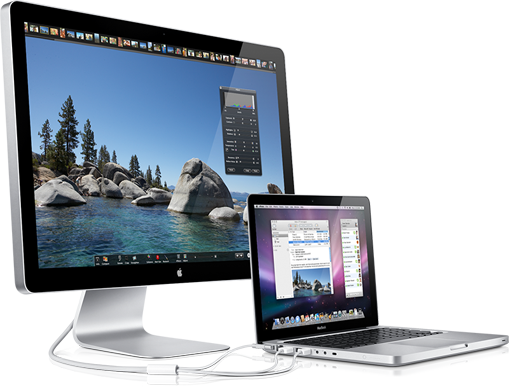
New Apple’s 24-inch LED Cinema Display.
Apple has recently announced the LCD screen that expands the screen of your new MacBook, MacBook Pro, or MacBook Air and takes you to a new level of experience. The LED Cinema Display connects to your new MacBook, MacBook Pro, or MacBook Air via the ultra-compact Mini DisplayPort connector, so you can say good bye to the old DVI or VGA connectors. This high-end LED screen also comes with a MagSafe connector, which is able to power and charge your new MacBook. Other features include the self-powered USB ports, the built-in iSight camera, microphone, and speakers.
Website: Apple.


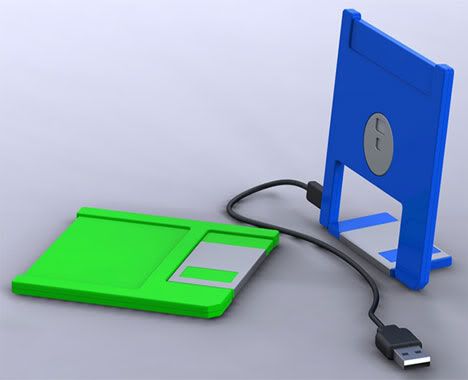
Floopy Disk Turned USB Drive, By Thomas O'Conner.
From the Coroflot portfolio of : Thomas O'Connor (Detroit, MI)
Featured Project : USB Floppy Drive
Bringing the 80's back for a reason is Coroflot member Thomas O'Connor: "The design is simple. My intention was to recycle/reuse old, outdated and obsolete 1.44mb floppy discs and reuse the housings to create modern, USB hard drives."
Experience Your Photos in 360 Degrees 3D.
Microsoft has announced the first full release of Photosynth, available now at photosynth.com.
You can share or relive a vacation destination or explore a distant museum or landmark. With nothing more than a digital camera and some inspiration, you can use Photosynth to transform regular digital photos into a three-dimensional, 360-degree experience. Anybody who sees your synth is put right in your shoes, sharing in your experience, with detail, clarity and scope impossible to achieve in conventional photos or videos.
Synths constitute an entirely new visual medium. Photosynth analyzes each photo for similarities to the others, and uses that data to build a model of where the photos were taken. It then re-creates the environment and uses that as a canvas on which to display the photos.
Source: LiveLabs.com
Alice Chess Set Features Pieces That Are Magically Transparent.
Inspired by the Lewis Carroll's novel ‘Alice through the Looking Glass,' designer Yasmin Sethi developed a chess set that features pieces that "magically turn transparent" when they touch the board. In other words, when removed from the playing surface, a pawn would be opaque—nearly indistinguishable from any other piece on the board. However, when in contact with the board, the piece reveals its true identity. This effect serves to remind the player that the pieces have no value unless they are in play.
The effect works thanks to a board made out of a glass material with embedded LEDs (LightPoints) and chess pieces made from clear glass with the negative shape of a traditional, delicate Staunton chess piece enclosed within it. Placing the chess piece on the board completes a circuit that illuminates the negative shapes, making them visible. There is even a clever nod to a passage in the book where the White Knight talks about being able to think better when he is upside down. In the Alice chess set, all of the white knights on the board will not illuminate unless placed in the upside down position. All-in-all, the 'Alice' concept is interesting new twist on the traditional game. With any luck, a real world product will come down the line sometime in the future. [Project Page via Pan-Dan via DVICE]
Source: Gizmodo.

Photos: Futuristic concept cars.
This year's auto-show season threw up a rich crop of cars that are never likely to make it to production in this decade. But who knows what features future cars will have? Solar panels? Mood-sensors? Video-game controls? Built-in Segways?
Check out our slideshow to see some of the more experimental ideas that major automakers are exploring.
Originally posted at The Car Tech blog
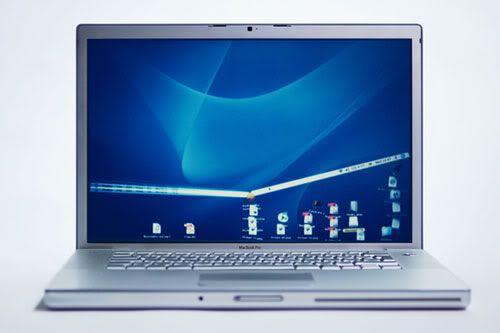
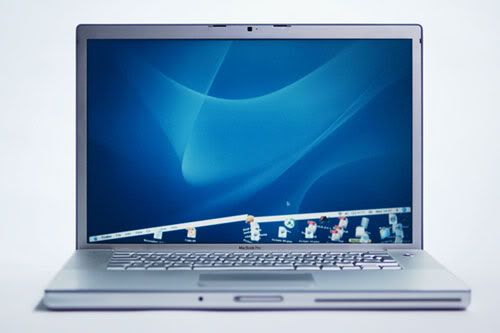
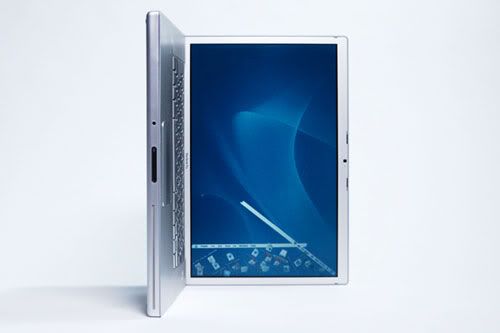
Newton Virus is The First Art Virus by Troika.
In the beginning were harmless computer viruses. Viruses born out of the wit of early computer adopters, viruses whose sole purpose was to surprise and amuse. A non-destructive form of artificial life.
We wanted to revive this golden era, and went on to create our first computer virus. We chose to do it for mac as the platform is still a virgin territory ;-)
Spice up your colleagues' day with our Newton Virus, the first virus to introduce gravity to your laptop, causing the desktop icons to fall down as if subject to the gravitational pull from the real world.
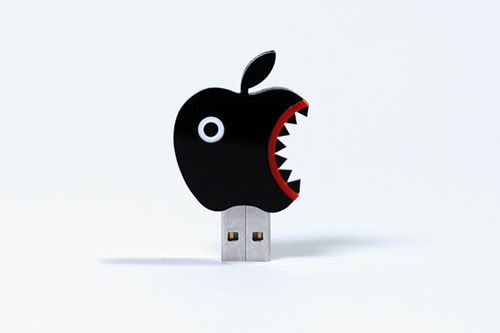
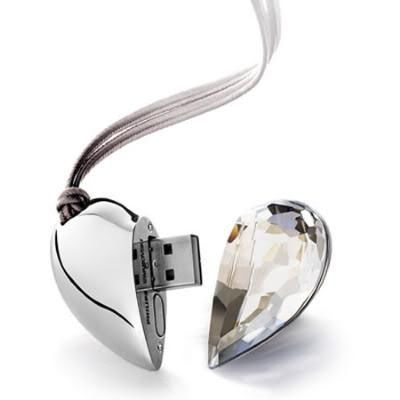
Newton Virus comes on a USB key for manual infection. Simply plug the key into a computer and the virus will automatically copy itself on the hard drive.
The virus will then hit at random, but only once. It will not replicate itself, mail itself to your friends or destroy any of your files, but instead provides you with moments of blissful surprise and magic.
Credits:
Concept & Design: Troika
Programming: Mauritius Seeger - Dr Mo
Picture:
Video:

Intel's 6-core Dunnington CPU coming this year, Nehalem gets official.
Intel Fact Sheet
Intel Corporation's Multicore Architecture Briefing
March 17, 2008 -- Intel Corporation today discussed upcoming leading edge microprocessors and technologies. Intel's 45nm high-k metal gate leading manufacturing technology is enabling the industry to move to multicore processors in all market segments, and Intel discussed future products with four, six, eight and many computing cores coming to the market.
Pat Gelsinger, Intel Senior Vice President and General Manager, Digital Enterprise Group:
Gelsinger disclosed details around Intel's multi-processor (MP) servers based on Intel's 6-core processor codenamed "Dunnington" and Intel's new Itanium processor codenamed "Tukwila." Gelsinger discussed current hot enterprise topics, including virtualization and the new SPEC power benchmark for measuring server energy efficiency, in which Intel-based systems hold all of the top 20 spots. He disclosed a number of technical features on two important products for Intel, Nehalem, Intel's next generation processor family and Larrabee, a future Intel product with many cores.
- Dunnington for Expandable (Multi-Processor) servers -- Intel's current 7300 chipset based platform combined with the Quad-Core Xeon 7300 processor is the industry's virtualization platform of choice for MP servers. Dunnington is socket-compatible with the Caneland platform and will be available in the second half of 2008. Dunnington is the first IA (Intel Architecture) processor with 6-cores, is based on the 45nm high-k process technology, and has large shared caches. Another supported feature is FlexMigration technology, which allows a single compatible virtualization pool that supports live VM (Virtual Machine) migration across both 65nm and 45nm high-k Intel Core™ microarchitecture-based servers and 45nm-based servers. This provides investment protection as well as the option to choose the right server platform to best optimize performance, cost, power and reliability.
- Tukwila delivers performance to the world's most powerful computers -- Tukwila is Intel's next-generation Itanium processor with four cores, 30MB total cache, QuickPath Interconnect, dual Integrated Memory Controller and mainframe-class RAS features. It is the world's first 2 billion transistor microprocessor and is projected to deliver more than double the performance of the current generation Itanium processor.
- Nehalem is Intel's dynamically scalable and innovative new processor microarchitecture -- Nehalem will provide dramatic performance and energy improvements to Intel's current industry-leading microprocessors. Nehalem is scalable with future versions having anywhere from 2 to 8 cores, with Simultaneous Multi-threading, resulting in 4 to 16 thread capability. Nehalem will deliver 4 times the memory bandwidth compared to today's highest-performance Intel Xeon processor-based systems. With up to 8 MB level-3 cache, 731 million transistors, Quickpath interconnects (up to 25.6GB per second), integrated memory controller and optional integrated graphics, Nehalem will eventually scale from notebooks to high-performance servers. Other features discussed include support for DDR3-800, 1066, and 1333 memory, SSE4.2 instructions, 32KB instruction cache, 32KB Data Cache, 256K L2 data and instruction low-latency cache per core and new 2-level TLB (Translation Lookaside Buffer) hierarchy. These technical improvements will result in performance improvements as well as flexibility for a wide range of eventual products based on the Nehalem architecture. Gelsinger also discussed the new Tylersburg platform, which can be configured for both one socket High End Desktop (HEDT) and two socket (HPC and dual processing server) operation.
- Visual Computing: Graphics Re-defined -- Visual Computing is redefining the visual and immersive high definition experience for computer users. Next-generation techniques for delivering naturally realistic gaming, graphics and high definition video and audio are driving increasing performance and architecture demands on the PC. For example, global illumination techniques such as ray tracing used to provide accurate shadow and lighting effect place greater performance demands on computers than traditional graphics. Behavioral realism in applications such as real-life physics in game titles or life-like display of human motion in medical imaging drive the need for more general purpose computing. Finally, entirely new levels of interactivity will emerge. For example, new forms of game controllers that can understand human motion will enable users to become characters in their favorite games. In medical imaging patient sensors will feed real time information to enable doctors to perform interactive computed guided procedures. In order to deliver on the promise of Visual Computing, a complete platform is required. This includes the multi-core CPU, chipset and graphics plus software and associated developer tools. Intel continues to increase its investment and pace in developing technologies, products and platforms that are fueling the pace of visual computing advancements.
- Larrabee Architecture for Visual Computing -- With plans for the first demonstrations later this year, the Larrabee architecture will be Intel's next step in evolving the visual computing platform. The Larrabee architecture includes a high-performance, wide SIMD vector processing unit (VPU) along with a new set of vector instructions including integer and floating point arithmetic, vector memory operations and conditional instructions. In addition, Larrabee includes a major new hardware coherent cache design enabling the many-core architecture. The architecture and instructions have been designed to deliver performance, energy efficiency and general purpose programmability to meet the demands of visual computing and other workloads that are inherently parallel in nature. Tools are critical to success and key Intel® Software Products will be enhanced to support the Larrabee architecture and enable unparalleled developer freedom. Industry APIs such as DirectX™ and OpenGL will be supported on Larrabee-based products.
- Intel AVX: The next step in the Intel instruction set -- Gelsinger also discussed Intel AVX (Advanced Vector Extensions) which, when used by software programmers, will increase performance in floating point, media, and processor intensive software. AVX can also increase energy efficiency, and is backwards compatible to existing Intel processors. Key features include wider vectors, increasing from 128 bit to 256 bit wide, resulting in up to 2x peak FLOPs output. Enhanced data rearrangement, resulting in allowing data to be pulled more efficiently, and three operand, non-destructive syntax for a range of benefits. Intel will make the detailed specification public in early April at the Intel Developer Forum in Shanghai. The instructions will be implemented in the microarchitecture codenamed "Sandy Bridge" in the 2010 timeframe.
Click here to download this fact sheet in PDF format. [PDF, 48KB]
About Intel
Intel, the world leader in silicon innovation, develops technologies, products and initiatives to continually advance how people work and live. Additional information about Intel is available at www.intel.com/pressroom and blogs.intel.com.
Source: Intel
















Google Sky, Mars, and Moon.
Google is extending the scope of its highly successful Google Earth satellite mapping technology into space with the launch of Google Sky. Google Sky, which is embedded into newes version of Google Earth. Sky provides Google Earth users a facility to explore the stars and galaxies sans the use of a telescope.
Google Sky delivers a zoomed in imagery of constellations into a user’s dekstop. With Sky’s technology, users can observe the movements of planets, stars and even watch a supernova explosion.
Explore beyond your world in your browser with Google Sky, Google Mars, and Google Moon.
http://sky.google.com
http://mars.google.com
http://moon.google.com
Video:
MacBook Air is Apple's newest laptop, and it's the thinnest laptop ever.
Video:
Website: Apple "Macbook Air"
Microsoft Surface (Codename: Milan), is a forthcoming Multi-touch product from Microsoft which is developed as a software and hardware combination technology that allows a user, or multiple users, to manipulate digital content by the use of natural motions, hand gestures, or physical objects. It was announced on May 29, 2007 at D5 conference, and is expected to be released by commercial partners in spring 2008. Initial customers will be in the hospitality businesses, such as restaurants, hotels, retail, and public entertainment venues.
Source
Video:
Microsoft "Surface" - The Magic
Microsoft "Surface" - The Power
Microsoft "Surface" - The Possibilities
Website: Microsoft Surface

-
Crayon Color Fun Facts & Photo Inspiration. For the last 100 years or so kids have been exploring and creating worlds of color with Cray...


Counter
